Greetings class,
This blog post is being written at Hub Comics, Somerville Massachusetts. I am desiring to give you all a bit more freedom in class to pursue your own ideas. However, it is important that you all use APPLIED KNOWLEDGE. Let us go over what we have learned in class!
* Story Structure
* Figure Drawing
* Abstraction
* Iconic drawing
* Perspective Drawing
Inner History
a unique history, world view and desire.
Visual distinction
A distinct and memorable body, face and wardrobe.
expressive traits
traits of speech and behavior associated with that character.
Where was your character raised? What kind of parents did they have? What's the best thing that ever happened to them? And the worst?
Who were their heroes? What were their struggles? All these things and more can help shape who they are.
Finding common ground between the experiences of your characters and those of the reader can help emotionally connect them --
While the differences in life experience between one character and another can trigger many stories.
A character raised in poverty, for example, may have trouble relating to a shopping-addicted heiress.
Don't obsess too much over such details is a class beginner's mistake.

Sunday, October 30, 2011

Wednesday, October 26, 2011
Figure drawing - Why we are studying figure drawing
Here we have 5 figure postures that I aquired from a CD-ROM of postures (over 600!). Comic book artists need reference in order to increase their vocabulary of drawing the human figure.
Today's assignment: In your notebooks or on loose paper, I'd like you all to attempt to draw these figures. When you are finished, pare up with a fellow student and do a 6th drawing from life where you will draw the other person.
You will have the class (2:45-4:00) to do 6 figure drawings. Organize your time correctly. You have 1 hour and 15 minutes. That equals roughly 10 minutes per figure drawing.
We will take some time to observe each other's work at the end of class.


STUDENT WORK!
 Xian has been paying attention and has produced a great story about the events that occur at school. Her character is an iconic "bean"

First off, let's observe some great student work that has been produced in class. Pai Ka has produced a clear, consise story about the perfect day at disney land. She is utilizing iconic language in the character's faces, perspective drawings on the rollercoasters and the story is clear to read. This is a triumph of what has been taught in class. She has been paying attention and is applying principles to drawing.

Christopher's "COOKIES" comic is sequenced PERFECTLY. HE also understands story structure and iconic language. Great stuff - great expressions! Great use of the panels. A+
Today's assignment: In your notebooks or on loose paper, I'd like you all to attempt to draw these figures. When you are finished, pare up with a fellow student and do a 6th drawing from life where you will draw the other person.
You will have the class (2:45-4:00) to do 6 figure drawings. Organize your time correctly. You have 1 hour and 15 minutes. That equals roughly 10 minutes per figure drawing.
We will take some time to observe each other's work at the end of class.


STUDENT WORK!
 Xian has been paying attention and has produced a great story about the events that occur at school. Her character is an iconic "bean"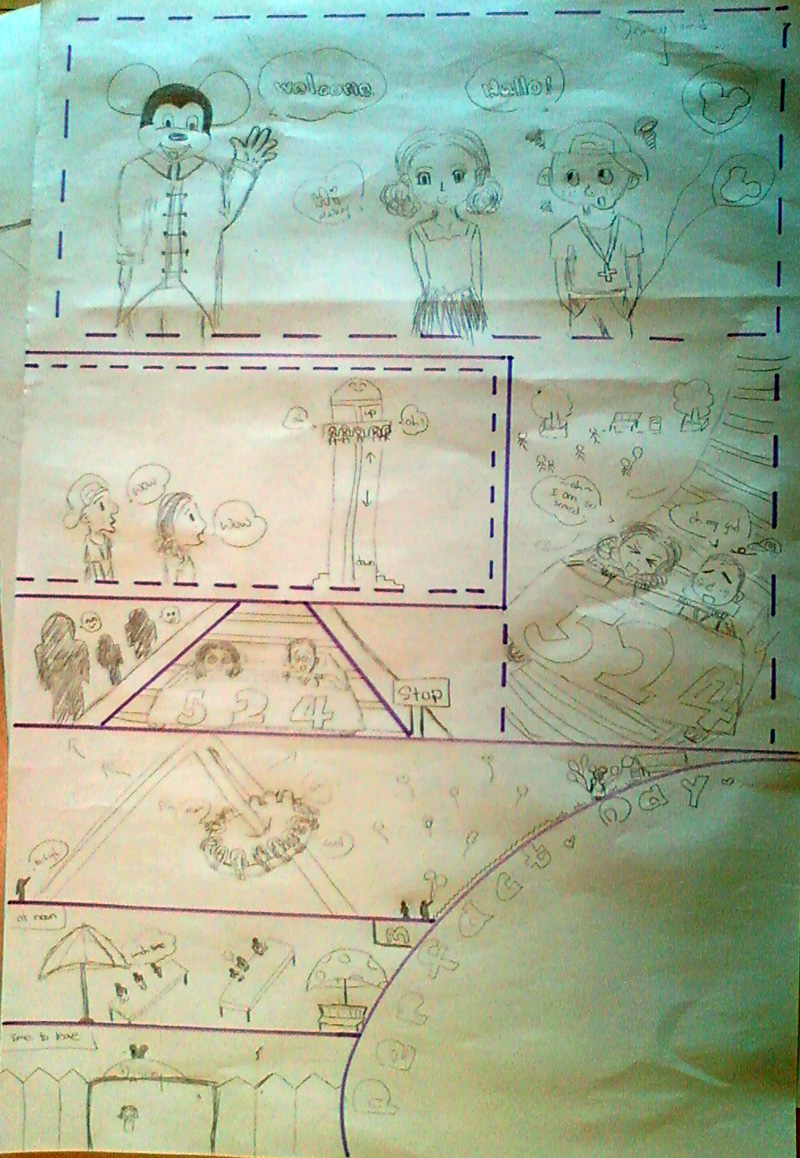
First off, let's observe some great student work that has been produced in class. Pai Ka has produced a clear, consise story about the perfect day at disney land. She is utilizing iconic language in the character's faces, perspective drawings on the rollercoasters and the story is clear to read. This is a triumph of what has been taught in class. She has been paying attention and is applying principles to drawing.

Christopher's "COOKIES" comic is sequenced PERFECTLY. HE also understands story structure and iconic language. Great stuff - great expressions! Great use of the panels. A+
Tuesday, October 11, 2011
The Written Word - Lesson 2 - the Introduction


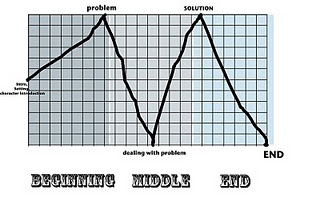
In class the other day, I presented to the class the Will Eisner story structure. As discussed in class, we are all aware of the fact that each story has a beginning, a middle and an end. Our each and every day falls into this catagory of storytelling.
example:
Beginning: I woke up.
Middle: I had lunch.
End: I went to bed.
What is this story missing? Why is this story boring?
********
The story is boring because there is a lack of PROBLEM. Nothing is being resolved, better yet, nothing is being told to begin with!
The Will Eisner story structure is used so that our stories are INTERESTING. You will find basically no books, no movies, nothing really, that doesn't fall into this story structure.
Last class, we devided pages into 5 PANELS and told the whole story. Michael did this beautifully with detail which is why I put his story on the blog in the previous post.
Today, you will be given 5 PANELS to make an introduction to a story.
This may sound daunting, but remember that an introduction is cast into multipule sections. The introduction of characters, the environment and the general "MOOD" of the story.
Use your characters that were created from a few weeks ago (when the characters "Scarecrow" and "Bulltron Mega" were introduced) ... introduce them to us. Where do they live?
You should accomplish this assignment with both WORDS and PICTURES. First, write words describing each one of your panels and number them. Example:
1. The first panel is an interior of a pizza place.
2. Bulltron Mega opens the door to his day working as a pizza delivery driver/chef.
3. His co-worker, says hello to him and he GRUNTS (this sets the mood).
4. He wipes down the counter and looks out the window at the sun.
5. A telephone call comes in.
Notice how the 5th panel LEADS into the second part of the story: the problem. Perhaps Bulltron Mega's problem is he has to go deliver a pizza!
Notice how the 5th panel LEADS into the second part of the story: the problem. Perhaps Bulltron Mega's problem is he has to go deliver a pizza!
NOTEABLE INTRODUCTIONS:
Observe the beginning of Dragonball Z and the beginning of a Wacky Racers comic. Is an environment introduced? Is there characters introduced? Arguably, the Wack Racers page is not a good example because the Wacky Racers are ALWAYS in a state of problem solving (they are always racing!). But these are nice examples.
Thursday, October 6, 2011
Story Structure Introduction


Here is a story told in both drawing and writing. Early on, we are told that stories are made up of BEGINNING, MIDDLE AND END. Three parts. There is another way of splitting up a story. It is called the "Will Eisner Story Structure".
Introduction - Showcase the environment, introduce the characters to the audience and establish a general mood and style.
Problem - introduce the conflict of the story.
Dealing with Problem - The series of events that help unravel the problem.
Solution - The problem is solved.
End - What is the conclusion? What did the characters learn? Why was the story important?
If you can come up with something for these five parts of a story, then you are telling a story with CONFLICT. Conflict, issues, problems ... stories need these in order to create EMPATHY, which is something we'll talk about later. For now, tell a story in five parts using the Will Eisner Story Structure.
Wednesday, October 5, 2011

 Here are two great examples from the abstraction lesson, although I am not quite sure what the emotion of the bottom character is. Remember: The point of the abstracted background assignment was to EXAGGERATE the emotion of the character by using abstract lines behind the character. With this said, I am happy with these two drawings and they should be seen by the class. Good job!
Subscribe to:
Posts (Atom)